


Mommy! He's bugging me!!




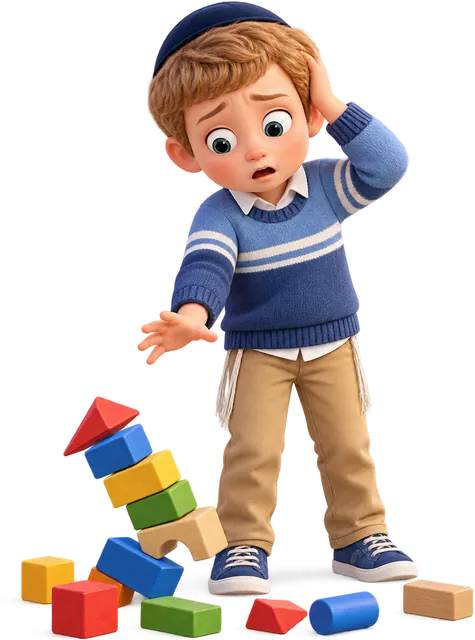


Nobody wants to play with me
I'm not good at anything
The teacher got mad at me again
I don't want to go to school!

Mommy, don't go!!
I'm scared to sleep alone
My rebbi got mad at me again
I'm not going to cheder today!
"Accurate assessment, proven results."
Sarah



Nice to meet you · Sarah Shugerman
Rosh Patuach, "an open mind," lives up to its name:
development starts in the head, in the brain.
For about 20 years, I've been helping children and teens
with learning and behavior difficulties move forward.
Therapy takes place in a warm home clinic in Neve Yaakov,
with one parent present.
He's smart, he's talented, and there's so much good in him.
There's just one thing that's hard for him.
It isn't bad chinuch, and it isn't that he doesn't want to.
Most of the time, it's one ability that isn't strong enough yet.
And the good news: an ability can be strengthened.
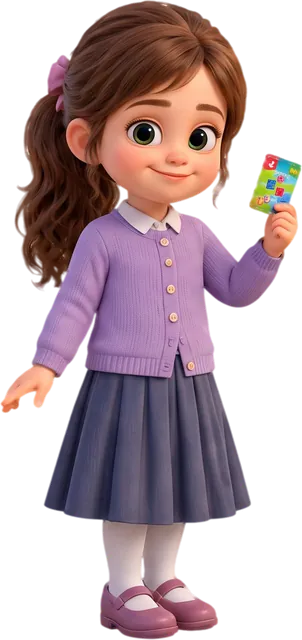
Her mind just opened up!
Mother of A.K.
Before we begin
Check what sounds familiar:
You deserve to have strong, good, independent children.
One assessment shows how your child's brain is built, where he's strong, and where the difficulty comes from.
Yes, I want to help my children move forward!The method
Sarah assesses and treats with the Cognitive Play method.
Just like at the gym, we find the ability that's weak,
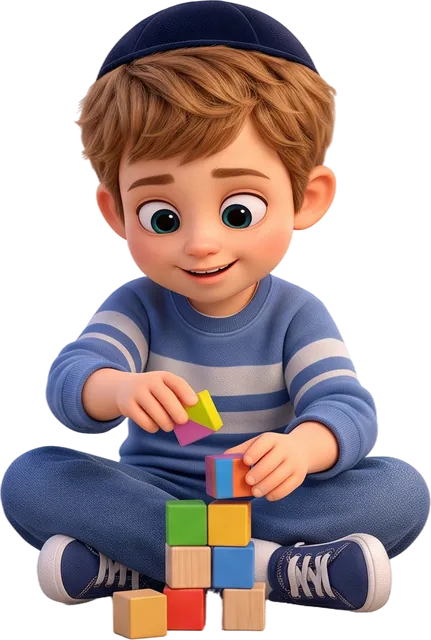
and train exactly that one, step by step, through play.
What's behind the behavior
Behind every familiar line hides an ability that isn't strong yet.
The assessment shows exactly which one.
Mommy! He's bugging me!!

Nobody wants to play with me
Huh? Did you call me?
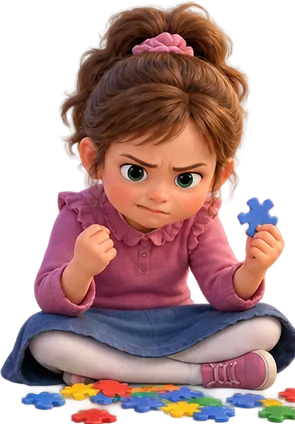
I just can't!
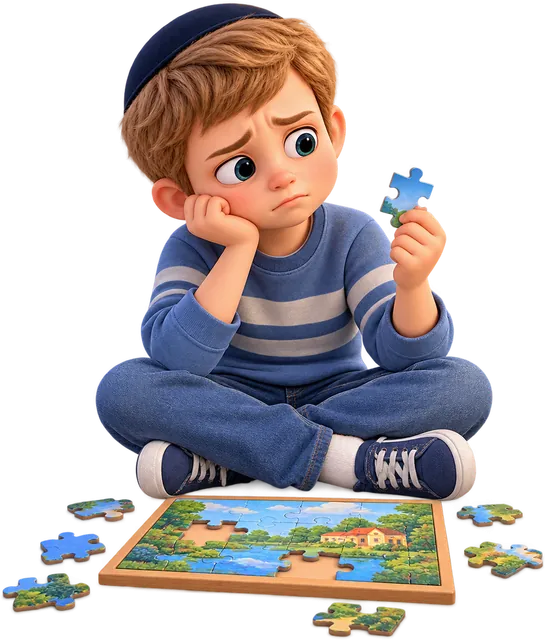
I can't sit still for this!

But you said we're going to the park!!
It's not perfect, I'm erasing it!
What's it called... um...
"We thought he'd grow out of it."
Almost every parent says that.
Usually it only changes shape.
What was small comes back bigger.
Arguments, phone calls from the rebbi,
and the routine revolves around the difficulty.

But you can start at any age.
The first step: understanding what's behind it.
One assessment that checks every area of development,
and gets to the root of the problem.
Tap an area to see what the assessment checks.
You tell her what's going on, and decide together whether an assessment is needed.
In a pleasant, fun atmosphere. Your child plays different games, and each game checks a different area of the brain.
A meeting with the parents, without the child: what the assessment showed, where the difficulties come from, and how to handle him at home and in cheder.
If you decide to go ahead with therapy, you're there at every session, and get tools to keep going at home.
A detailed explanation of the strengths and the weaknesses.

How to handle your child at home.
To help you understand and cope at home.
You'll leave clear and focused.
You'll know exactly what's going on with your child and what needs to be done.
You'll learn to accept the weaknesses and strengthen them,
and lead your child toward a better future.
Parent guidance
Therapy happens at the clinic,
but life happens at home.
At no extra cost.
Sarah is a certified guide with the Shtulim organization,
using the method of Rabbi Yechiel Pleskin.
"So why not just play with him myself?"
There's playing at home, and there's playing in therapy.
The difference is why we play, what we play, and what we notice along the way.
Playing at homeFun, closeness and warmth. Keep it up!Therapy at Rosh PatuachPlay with a purposeFor fun and connection.
To strengthen a specific ability the assessment found.
Whatever's at home and whatever he likes.
A game chosen especially for that ability.
Always the same. Sometimes too easy, sometimes frustrating.
Matched exactly to the child, and it gets harder step by step.
Who won.
How the child thinks, where he gets stuck, and why.
Good time together.
A stronger ability, and tools to keep going at home.
So yes, keep playing with him.
And when something is stuck, it takes a game aimed right at it.
These studies deal with training children's abilities in general, not with this specific method.
Sources: Diamond & Lee, Science 2011 · Harvard Center on the Developing Child
"I can attest to her deep understanding of the many aspects of child development, and to her unique ability to help children overcome learning and attention difficulties and emotional problems through cognitive play. I highly recommend her."
"After a year of therapy, we have a different child."
"Baruch Hashem, we went from darkness to light."
"In under half a year, we're seeing calm and real progress."
All the stories are real, with details changed to protect privacy.
Every child is different, and so are the results.
Any age. Most clients are children and teens, boys and girls, but the method works for adults too.
No. It's a cognitive-developmental assessment through play: it maps which of your child's abilities are strong and which need strengthening. It doesn't replace an assessment by a doctor or a psychologist.
No. There's no diagnosis and no label here. What comes out of the assessment is an understanding of how your child thinks, what's strong and what's worth strengthening.
Occupational therapy, remedial teaching and emotional therapy all help a lot, each in its own field. Sarah's assessment looks for the root: which ability is behind the difficulty. Sometimes Sarah will recommend adding another therapy as well.
Yes. Therapy takes place with a father or mother in the room, fully transparent, so you can carry it on at home.
No. Decisions about medication belong to the doctor. Play therapy can go hand in hand with medical care.
It differs from child to child. After the assessment you'll have a clear picture and a defined goal, and you decide whether to continue.
At the clinic in Neve Yaakov, Jerusalem. We'll gladly go over the cost by phone: 050-4170805
Tell Sarah what's going on, and together you'll figure out the next step.
Call 050-4170805